Voltage fluctuations are one of the most common power problems in Nigeria. Grid voltage can swing well above or below the levels your equipment is designed to handle, causing damage, reduced lifespan, and unexpected failures. A servo voltage stabilizer provides the most precise voltage regulation available, making it the preferred choice for protecting valuable equipment in homes, offices, and industrial settings.
What Is a Servo Voltage Stabilizer?
A servo voltage stabilizer uses a servo motor to continuously adjust the output voltage, maintaining a stable level regardless of input voltage fluctuations. Unlike relay stabilizers that switch between fixed voltage taps, a servo stabilizer provides smooth, continuous correction — typically achieving ±1% output accuracy even when input voltage varies by ±50%.
For a detailed comparison of stabilizer types, see our relay vs servo voltage stabilizer guide.
Why Servo Stabilizers Are Essential in Nigeria
Nigerian power supply is characterized by frequent voltage fluctuations. Low voltage can cause motors in air conditioners, refrigerators, and pumps to overheat and burn out. High voltage can instantly damage electronic circuit boards in TVs, computers, and other equipment. The cost of replacing damaged equipment far exceeds the cost of a quality stabilizer.
Servo stabilizers are particularly important for:
- Air conditioners and refrigerators: Compressors are especially sensitive to low voltage, which causes them to draw excess current and overheat.
- Medical equipment: Requires stable voltage for accurate operation and patient safety.
- Industrial machinery: Voltage fluctuations cause production errors, equipment damage, and downtime.
- IT and communication equipment: Sensitive electronics can be permanently damaged by voltage spikes.
- Home entertainment systems: TVs, sound systems, and gaming consoles have delicate circuitry that voltage fluctuations can destroy.
Advantages of Servo Stabilizers Over Relay Stabilizers
While relay stabilizers are cheaper, servo stabilizers offer significant advantages that justify the higher cost for valuable equipment:
- Higher precision: ±1% output accuracy vs ±10% for relay stabilizers.
- Faster correction: Servo motor adjusts continuously rather than switching between fixed taps.
- Higher capacity: Servo stabilizers are available in much larger capacities (up to hundreds of kVA) for industrial applications.
- Better durability: Servo stabilizers handle sustained fluctuations better than relay types, which wear out from frequent switching.
- Smoother output: No voltage jumps between taps — the output transitions smoothly.
Key Features to Look For
When choosing a servo voltage stabilizer, look for these essential features:
- Wide input voltage range: Should handle the full range of fluctuations in your area.
- High/low voltage cutoff: Automatically disconnects if voltage exceeds the stabilizer’s range.
- Overload protection: Protects the stabilizer itself from damage.
- Surge and spike suppression: Handles sudden voltage spikes from lightning or grid switching.
- Bypass switch: Allows you to bypass the stabilizer for maintenance without disconnecting power.
- Single-phase prevention and phase reversal protection: Important for three-phase systems.
Sizing Your Servo Stabilizer
Choose a servo stabilizer with a capacity (kVA) that matches or exceeds the total load of the equipment it will protect. For equipment with motors (ACs, refrigerators, pumps), account for starting surge current, which can be 2-3 times the running current. Undersizing the stabilizer will cause it to trip frequently and may damage both the stabilizer and your equipment.
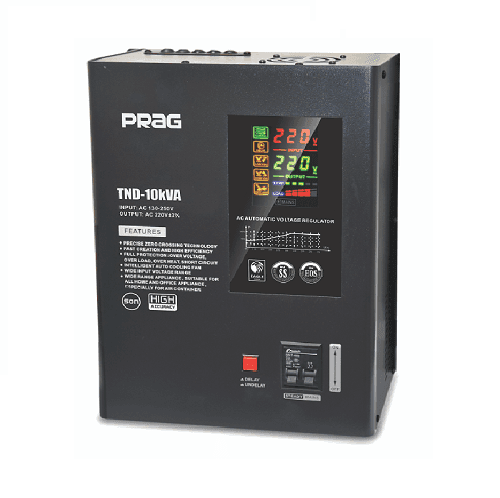
Need a servo voltage stabilizer? Explore PRAG servo voltage stabilizers for reliable equipment protection.